Quicken Classic for Mac is a good personal finance tool—it simplifies and automates most of my financial tracking. But there are a few tasks I do manually every month:
- Entering transactions for banks that don’t support Quicken Transaction download.
- The dreaded task of categorizing Amazon transactions.
Not anymore. Both of those are now automated.
Anthropic recently released a beta feature for Claude Cowork which allows it to control a Mac.
Image generated using ChatGPT (DALL·E), March 2026
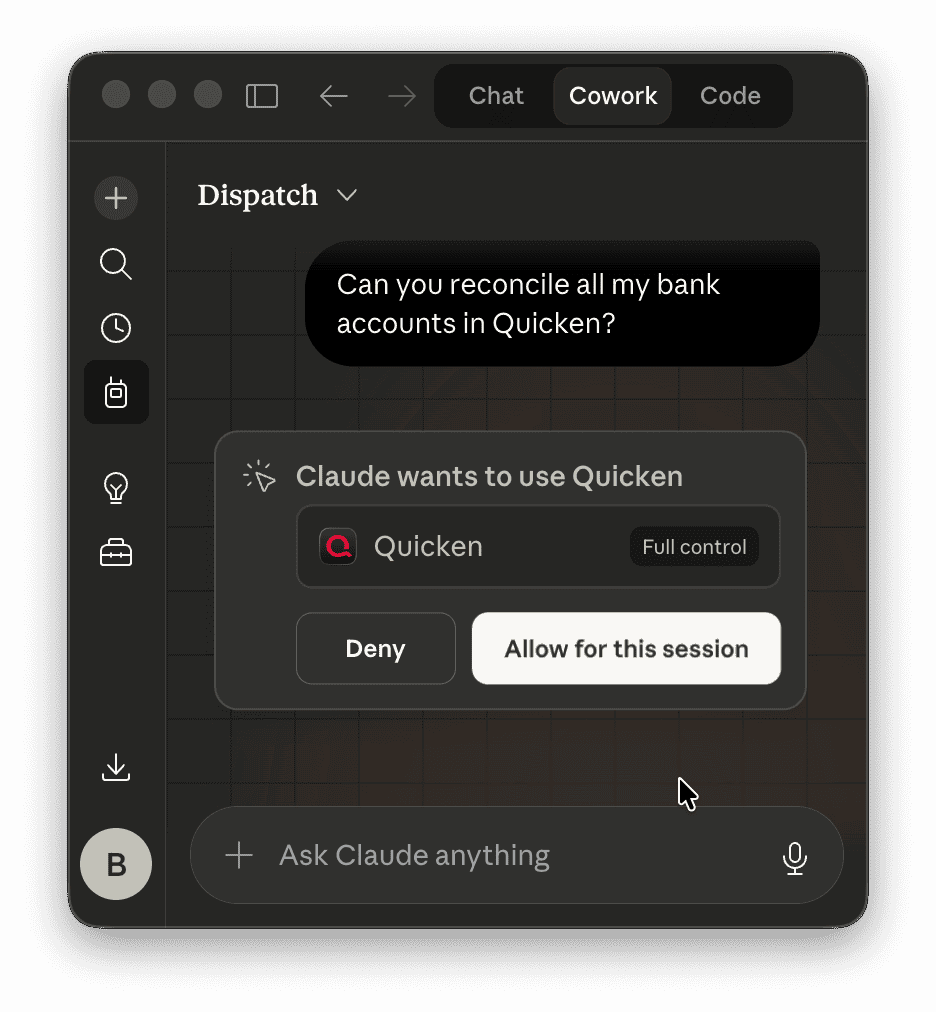
A simple prompt:
“Can you reconcile my [x] account with Quicken?”
And the next thing I know Claude Cowork is on my bank website, finds the transaction history, enters all the missing transactions, and does the reconcile in Quicken.
And for categorizing Amazon transactions:
“For each unreviewed transaction in Quicken in my Amazon Visa account, categorize it (ask me if unsure) using Amazon’s transaction history.”
And it goes to Amazon, finds my orders, and categorizes each one. I didn’t have to teach it what categories I used; it searched for things that made sense until it found the best match.

AI just saved a couple of hours of work each month. And Quicken for Mac doesn’t support MCP; this is interacting with the computer like a human would.
I wouldn’t say it’s fast; it was slower than me, but I sat down and watched a movie with my family while it worked. It kept me updated via messages to my phone so I could have been on a walk or wherever to answer any questions it had. This is like texting Jarvis to do a task for you. I could be out on a hike, have an idea, send Claude a message, and the work would be done on my Mac before I get back home.
It’s not seamless. Claude did ask me to log in to the bank, and I did have to answer a few questions. But I’m confident these rough edges will be worked out over time.
Now, this automation could have been done with some scripting or RPA (Robotic Process Automation)–but I didn’t have to spend hours writing the scripts, and using AI makes the process less likely to break when Quicken releases an update or the websites change. It took 10 seconds to hand that task off to Claude.
This is the first phase of Agentic AI. Automating scutwork with a sentence.
This is great, but we have to remove a very distinctive social convention from how we think about computers.
Without machine learning, a computer is really, *really* good at math. Asking it to perform 2248621+683737438 is absurdly simple to it. You ask the same question 500 times, you can expect the same answer.
*With* machine learning, though, the computer is working off of averaged-out things, and it can screw up if average actions it imitates have screwed up. 2248621+683737438 will *usually* yield 685986059, but it has a nontrivial chance of being wrong.
Therefore, we need to turn off the machine learning to have the computer validate its work. Nobody will ever talk about this in the marketing copy, but we’ll definitely hear about it later when the liability lawsuits start flying.
Hi, Greg! I ran your math problem through a few AI providers–Gemini wrote a Python script, ChatGPT appears to have passed it off to an internal calculator, and I couldn’t tell what Claude did. All got the correct answer …this time (admittedly I didn’t ask the models 500 times). That said, you have a great point in that one could easily make wrong assumptions about the accuracy of AI from their experience of being able to trust Excel. My experimentation with LLMs is that they can be helpful in some areas–and completely incapable and often wrong in others. I think the best thing for AI users to do is to increase their AI literacy, such as this module from Anthtopic Academy: https://anthropic.skilljar.com/ai-fluency-framework-foundations to build up competencies on when and how to use AI. Note that I don’t necessarily agree with the worldviews of the instructors, but they did build a decent module.
How much did it cost?
I have no idea! It was included in my subscription (Pro).